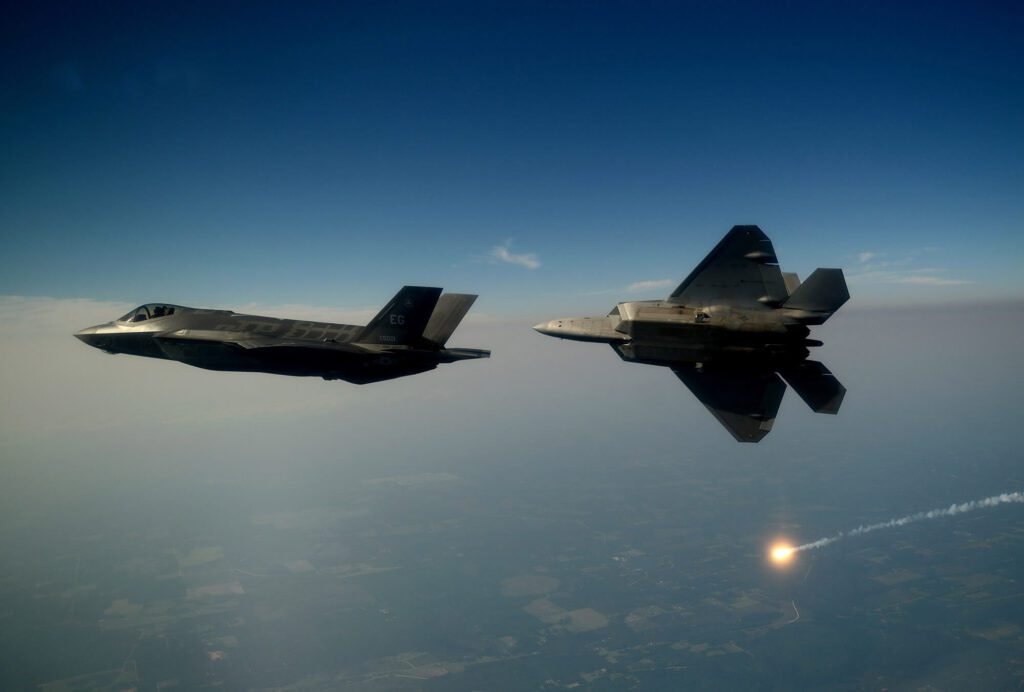
F-22 Raptor developed by Lockheed Martin alongside Boeing represents pure aerial combat excellence through U.S. Air Force’s Advanced Tactical Fighter (ATF) program. This aircraft first flew in 1997 and entered service in 2005, embodying Cold War era ambitions for absolute air dominance against peer adversaries. Designed with superior thrust-vectoring nozzles and extraordinary maneuverability, only 187 units were built before production stopped in 2011. Exports remain allowed due to classified technology restrictions, keeping its footprint relatively small across U.S. bases.
F-35 Lightning II emerged from the Joint Strike Fighter (JSF) program, aiming to produce something fundamentally different—a versatile multirole fighter with three variants serving multiple countries. Used by allied forces across 26+ bases, this platform joined active service in 2015 after its first flight in 2006. Loaded with advanced sensor fusion, electronic warfare systems, and Distributed Aperture System (DAS), over 1,150 aircraft have been delivered worldwide, logged million flight hours. The F-35A handles conventional takeoff and landing, F-35B manages short takeoff and vertical landing, while F-35C specializes in carrier operations.
Read more – Lockheed Martin F-22 Raptor
| Feature | F-22 Raptor | F-35 Lightning II |
| Role | Air Superiority Fighter | Multirole Stealth Fighter |
| Manufacturer | Lockheed Martin | Lockheed Martin |
| First Flight | 1997 | 2006 |
| Introduced | 2005 | 2015 |
| Top Speed | Mach 2.25 (~2,414 km/h) | Mach 1.6 (~1,975 km/h) |
| Range | ~2,960 km (1,839 miles) | ~2,200 km (1,367 miles) |
| Thrust Vectoring | Yes (superior maneuverability) | No |
| Stealth | Excellent (optimized for air superiority) | Excellent (optimized for multirole missions) |
| Radar | AN/APG-77 AESA | AN/APG-81 AESA |
| Weapons Capacity | 8 (internal) + external hardpoints | 4–6 (internal) + external hardpoints |
| Combat Radius | ~800 km | ~1,000 km (varies by variant) |
| Variants | F-22A (only version) | F-35A (Air Force), F-35B (Marine STOVL), F-35C (Navy Carrier) |
| Unit Cost (approx.) | ~$150 million | ~$80–110 million (varies by version) |
| Production Status | Discontinued (187 built) | In production |
| Export | Not for export | Exported to multiple allied nations |
The Best America Has to Offer
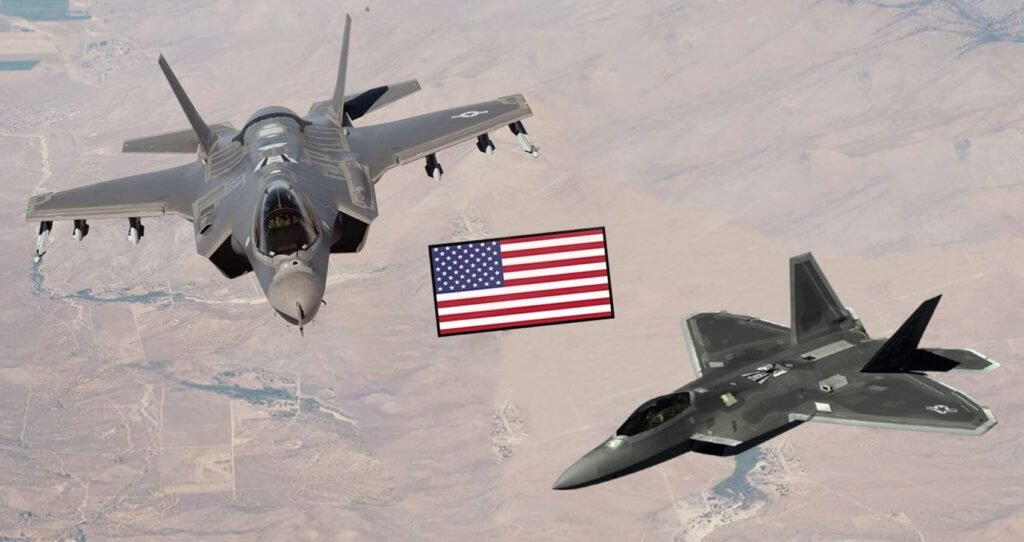
The F-22 Raptor and F-35 Lightning II represent cutting-edge, fifth-generation aircraft that showcase U.S. technological dominance through advanced stealth technology and sophisticated avionics. Both fighters demonstrate America’s commitment to maintaining air superiority with state-of-the-art stealth technology, positioning them as undisputed rulers of modern skies. These jets weren’t just designed for show; they’re built to dominate air-to-air engagements while staying virtually invisible.
Having witnessed the F-35 Lightning II Demo Team perform at the Abbotsford International Airshow, I can attest that America’s advanced fighter jets create an intimidating presence through their smooth airframe shaping and raw capability. The debate surrounding these world-class platforms often centers on their specialized roles, yet both excel at winning air battles with radar-absorbent materials and enhanced electronics. Their weaponry systems and sensors create a lethal opponent package that enemy forces struggle to counter effectively.
Read More – Lockheed Martin F-35 Lightning II
| Feature | F-22 Raptor | F-35 Lightning II |
| Generation | 5th Generation | 5th Generation |
| Primary Mission | Air Superiority | Multirole (Air-to-Air, Strike, Recon, EW) |
| Stealth Capability | Advanced (optimized for air-to-air) | Advanced (optimized for multirole operations) |
| Avionics & Sensors | High-end, less integrated than F-35 | Cutting-edge sensor fusion (360° situational awareness) |
| Airframe & Design | Smooth, high-agility, thrust-vectoring | Sleek, stealth-optimized, versatile |
| Maneuverability | Superior agility, supercruise capable | Excellent handling, but less agile than F-22 |
| Weapon Systems | Optimized for aerial combat | Versatile: air-to-air, air-to-ground, electronic warfare |
| Presence & Intimidation | Dominating in dogfights | Powerful in both conventional and stealth roles |
| Operational Use | USAF exclusive, elite air dominance tool | Widely deployed by U.S. and allies |
| Public Impact | Rarely seen, elite platform | Demonstration teams impress worldwide audiences |
| Demo Performance | Limited appearances | F-35 Demo Team = high-profile showcases |
Speed & Agility / Maneuverability and Speed
Agility in dogfights becomes critical when pilots engage within close-range scenarios. The Raptor achieves supercruise capability, maintaining speeds exceeding Mach 1.5 without afterburners, while vectoring technology allows unprecedented control. Its maneuverability remains unmatched in air-to-air combat, where agile movements and speed combine to dominate contested airspace. The aircraft reaches speeds of Mach 2.25, giving pilots a decisive height advantage during engagements. This flying platform was designed specifically for air dominance, where powerful radar and thrust vectoring make it nearly impossible for adversaries to keep up.
The Lightning sacrifices raw speed for broader mission flexibility, with a top speed of Mach 1.6. It does not have supercruise capability but compensates through advanced sensor fusion and networking. While not quite as stealthy from all angles, this fifth-generation fighter jet still excels in contested environments. The aircraft can fly efficiently around 50,000 feet, focusing on versatile operations rather than pure acceleration. Its agility proves sufficient for modern threats, though it would struggle in traditional within-visual-range (WVR) encounters against the Raptor’s superior thrust control.
| Feature | F-22 Raptor | F-35 Lightning II |
| Top Speed | Mach 2.25 | Mach 1.6 |
| Supercruise | Yes (Mach 1.5+) | No |
| Agility | Superior (thrust vectoring) | Adequate for multirole use |
Designed for Different Missions (Stealth)
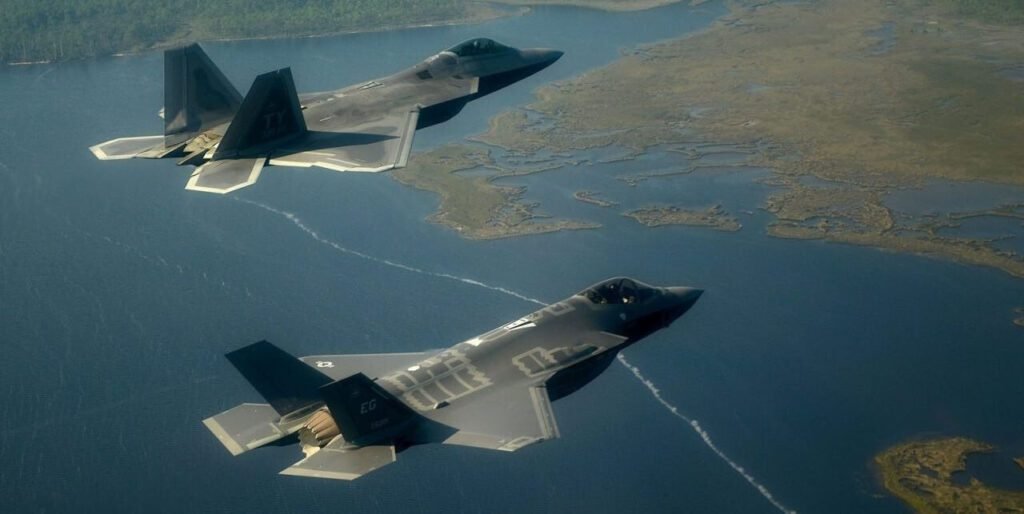
Stealth optimization defines both aircraft differently, yet their radar cross-section philosophies diverge fundamentally. The design emphasizes stealth features through extremely low signatures, making detection difficult for enemy systems. Its latest stealth aircraft technology integrates advanced sensors that work seamlessly with stealth optimized airframes. Meanwhile, the other platform achieves superior stealth through different geometric approaches and coating materials. Both jets incorporate electronic warfare capabilities that complement their low-observable characteristics during strike operations and surveillance tasks.
Combat effectiveness hinges on how stealth advantages translate into detecting threats first during engagements. One fighter’s unmatched ability to remain hidden gives it critical advantages in beyond visual range (BVR) combat scenarios. The avionics suite supports pilots through integration with systems like the AN/APG-81 AESA radar and Electro-Optical Targeting System (EOTS). These features make both platforms invaluable for modern combat environments where remaining undetected determines mission success. Pilots leverage 360-degree view capabilities through helmet-mounted displays, ensuring complete battlespace awareness while maintaining minimal signatures.
| Feature | F-22 Raptor | F-35 Lightning II |
| Stealth Focus | Air-to-air stealth optimized | Multirole stealth across all domains |
| Radar Cross-Section (RCS) | Extremely low — optimized from all angles | Very low — best from frontal aspect |
| Stealth Design Approach | Smooth lines, edge alignment, internal bays | Angled surfaces, radar-absorbing coatings |
| Key Radar System | AN/APG-77 AESA | AN/APG-81 AESA + EOTS |
| Sensor Fusion | Advanced, but less integrated than F-35 | Highly integrated multi-sensor fusion |
| 360° Situational Awareness | Partial (no HMD with full fusion) | Full — via HMD and Distributed Aperture System (DAS) |
| Electronic Warfare (EW) | Integrated but limited compared to F-35 | Advanced EW suite for jamming & suppression |
| Ideal Stealth Mission | Penetrate contested airspace & win WVR/BVR | Strike, surveillance, SEAD, and BVR combat |
Weaponry and Versatility
Striking ground targets while collecting intelligence demands a multirole platform that can handle multiple tasks seamlessly. The F-35 was never meant for pure air-to-air combat alone; its advanced communication systems enable coordinating other forces in complex modern battlefields. This adaptability proves valuable when missions rely on sensor fusion and networking capabilities rather than traditional dogfights. CAS and EW operations require an aircraft equipped to engage threats before being seen, making it well-suited for broader military context. The ability to adapt under environmental factors and share data across platforms transforms how joint coalition environments function today.
Long-range missiles and electronic countermeasures shift engagement dynamics beyond close-range engagement scenarios. Depending on engagement geometry, a pilot’s tactics and specific conditions of the scenario, the outcome could depend heavily on electronic warfare capabilities. The first missile launch might allow one fighter to level the playing field before defensive tactics become necessary. Both can perform strike missions effectively, yet the more versatile option offers a much wider range of operational possibilities. Whether forced into reactive measures or maintaining situational awareness, the different strength each brings defines their role in modern military aviation.
| Category | F-22 Raptor | F-35 Lightning II |
| Primary Role | Air Superiority (with limited strike capability) | Multirole (strike, air-to-air, EW, ISR, CAS) |
| Air-to-Air Weapons | AIM-120 AMRAAM, AIM-9 Sidewinder | AIM-120, AIM-9X, Meteor (partner nations) |
| Air-to-Ground Capability | Limited — JDAMs, SDBs | Extensive — JDAMs, SDBs, JSOW, laser-guided bombs |
| Strike Versatility | Focused, fewer munition options | Broad strike portfolio, multi-mission capable |
| Electronic Warfare (EW) | Basic EW systems | Advanced EW suite (jamming, spoofing, suppression) |
| Sensor Fusion | Present, but less integrated | Highly integrated — real-time data sharing |
| Close Air Support (CAS) | Not designed for CAS | Can perform CAS, especially F-35B variant |
| Network-Centric Warfare | Limited | Core strength — acts as a battlefield coordinator |
| Data Sharing / Coordination | Moderate (legacy link capabilities) | Extensive — Link 16, MADL, sensor-to-shooter |
| Overall Mission Flexibility | Limited — specialized air dominance | High — adaptable to evolving mission needs |
Logistical and Operational Standpoint
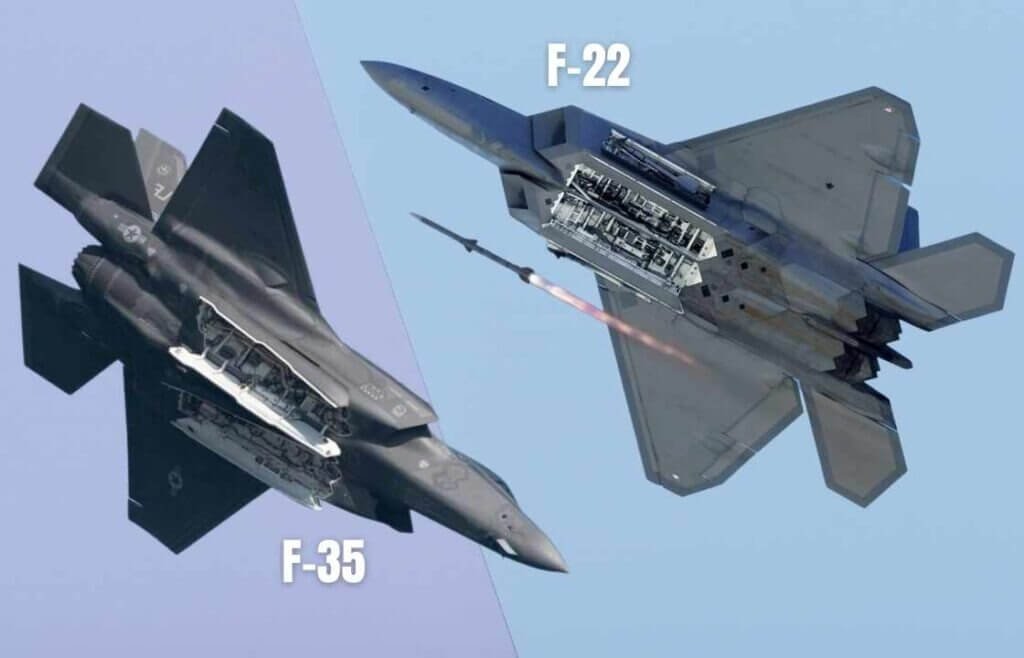
From a logistical perspective, the F-35 emerges as the more practical choice for day-to-day military operations. Its globally widely adopted design ensures 180 units can operate effectively across two decades of service. The goal of ensuring a wide range of missions makes it tailored to replace variety of legacy aircraft in the U.S. military and aircraft fleet.
Jointly developed as a key part of modern defense strategy, it was built to take on diverse operational demands. The incredibly fast production timeline and later deployment phases made it much more accessible than its older counterpart. This making the Military choose practicality over pure dominance represents what the article calls a strategic shift in how forces prepare for war.
| Aspect | F-22 Raptor | F-35 Lightning II |
| Production Scale | Limited (≈187 built) | Large-scale (1,000+ units globally) |
| Operational Flexibility | Specialized (air superiority) | Multirole — replaces several legacy aircraft |
| Maintenance & Logistics | Complex, costly | Streamlined for global use |
| Deployment Reach | U.S. only | Widely used by U.S. and allied nations |
Altitude and Reach
High altitude capabilities make the Raptor a flying marvel that operates where much higher zones exist. Its twin engines generate raw power for sustained climbs, while the much larger airframe houses systems optimized for extreme elevations. The jet misses nothing with its absurdly powerful radar scanning from altitudes where enemies rarely venture.
This spaceship-like performer reaches elevations faster than adversaries can respond, creating huge tactical advantages. At these heights, the radar tracks targets across vast distances, functioning as an airborne sentinel. Meanwhile, its counterpart focuses on versatility rather than pure altitude dominance, proving no point exists in direct vertical performance comparisons.
- F‑22 Raptor
• Service ceiling: ~65,000 ft (≈ 19,800 – 20,000 m)
• Ferry (maximum) range: ~2,960 km (≈ 1,840 miles) with external tanks
• Combat radius (loaded WVR / clean): ~740 km (≈ 460 miles)
- F‑35 Lightning II (F‑35A baseline)
• Service ceiling: ~50,000 ft (≈ 15,000 m)
• Combat (internal fuel) range: ~1,239 km (≈ 770 miles)
• Maximum range (internal + external, depending on configuration): ~2,800 km (~1,500 nmi)
Raptor vs Lightning Analysis
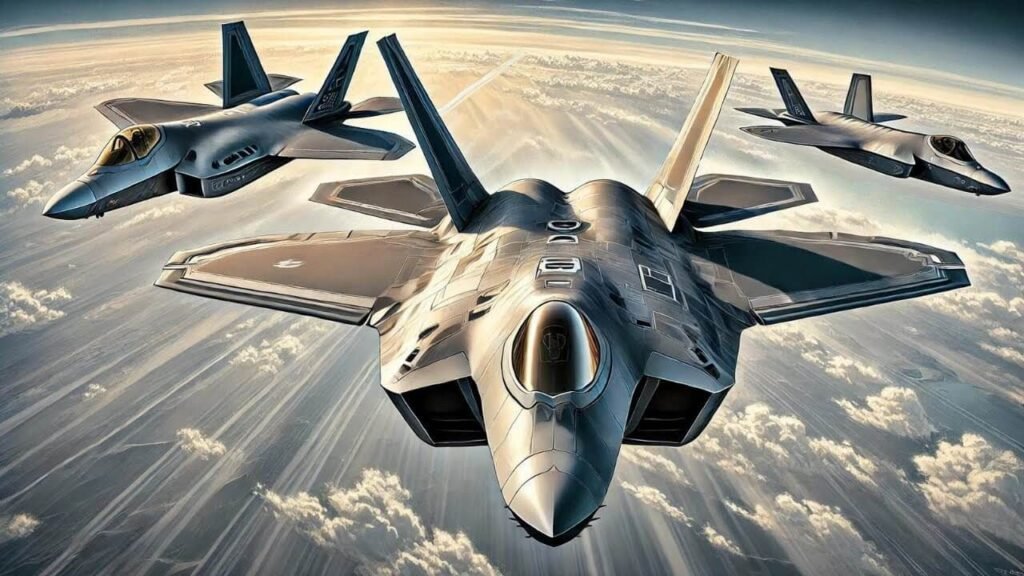
The Lightning maxes out at Mach 1.6 while the Raptor achieves a top speed of Mach 2.25, making speed a clear differentiator. Fast intercept missions demand superior climb rate characteristics that outpace conventional designs. The Raptor’s thrust-vectoring engines and aerodynamic design create almost unrivalled capabilities in dynamic airspace. Its thrust-to-weight ratio enables maneuvers that outmaneuver virtually any adversary during dogfight scenarios.
The Lightning remains agile enough for most combat scenarios despite its lower thrust-to-weight ratio. It lacks thrust vectoring and isn’t designed for extreme maneuverability, creating a disadvantage in pure aerial duels. However, being better suited for multi-role flexibility compensates where raw performance falls short. As one of the most agile fighters ever built, the Raptor can defeat enemy fighters with unmatched precision, though the Lightning proves superior in versatility across varied mission profiles.
| Feature | F‑22 Raptor | F‑35 Lightning II |
| Top Speed | Mach 2.25 (Machtres Aeronautica y Espacio) | Mach 1.6 (Wikipedia) |
| Thrust-to-Weight Ratio | ~1.08 (at loaded weight) (Machtres Aeronautica y Espacio) | 0.87 (gross weight) (Wikipedia) |
| Maneuvering Advantage | Has thrust vectoring → extreme agility, superior performance in dogfights | No thrust vectoring; adequate maneuvering but less extreme |
Frequently Asked Questions (FAQs)
Is F-22 better than F-35?
The F-22 is superior in air-to-air combat and stealth, while the F-35 excels in multirole versatility and advanced sensors.
Can any fighter beat F-22?
In one-on-one air combat, very few jets can challenge the F-22, though modern systems like the Su-57 or NGAD may pose a threat with the right tactics.
Which fighter jet can defeat the F-35?
Stealth-capable 5th-gen jets like China’s J-20 or Russia’s Su-57 could theoretically challenge the F-35, but it heavily depends on the scenario and pilot skill.
Is there a jet better than the F-22?
The upcoming NGAD (Next Generation Air Dominance) jet is designed to surpass the F-22 in stealth, range, and advanced systems.
Is the Rafale better than F-22?
The Rafale is a versatile and capable 4.5-gen fighter, but the F-22 outclasses it in stealth, speed, and air superiority roles.
What is the most advanced fighter jet?
As of now, the F-35 is considered the most advanced operational fighter due to its sensors, network capabilities, and multirole flexibility.
Read more Blogs here:
Unlock Frehf (The Ultimate Human-AI Awakening Solution)
CHAS6D Secrets: Transform Your Digital Matrix Experience
Erome What Powerful Matrix Truth Revealed
Final Comparison
Examining vs. these jets reveals a paradox where mission context determines supremacy. The F-22 would almost certainly overpower its counterpart in close quarters combat, leveraging superior speed and maneuverability to outperform decisively. However, beyond-visual-range engagements could level the playing field significantly, as advanced sensor fusion might allow earlier threat identification. Each aircraft’s strengths vary dramatically based on engagement parameters and operational theater requirements.
The final conclusion splits the verdict between tactical dominance and strategic value. While one-on-one dogfight scenarios favor the Raptor, the Lightning brings numerous operational advantages that matter more in modern warfare. Both aircraft remain highly survivable in contested environments, yet their fare against each other depends on which fighter controls engagement distance. This comparison ultimately shows why hypothetical fight analyses must consider that superior aircraft performance isn’t just about winning individual battles.

Zainab Farooq is a dedicated reporter and celebrity wealth analyst with Pakistan Coverage, committed to bringing readers timely and accurate information across diverse topics. With a passion for storytelling and fact-based reporting, she covers everything from celebrity net worth insights and entertainment industry analysis to local Pakistani developments and global trends, ensuring readers stay informed about the stories that shape our world.